Jump to HeaderJump to Main ContentJump to Footer
Michigan State University
Industrial Training and Assessment Center

Apply:

  • Clients
  • Students
  • DOE ITAC Program

Industrial Training and Assessment Center

  • About
  • |
  • Clients
  • |
  • Team
  • |
  • Student Recruitment
  • |
  • Workforce Development
  • |
  • Resources
    • Government Resources
    • KUKA Case Study
    • Common Recommendations
    • DOE ITAC Grant
    • Topical Resources
    • Utility Rebates and Incentives
    • Energy Resilience
    • Emergency Demand Response
    • Cybersecurity
  • |
  • Related Programs
    • BTAC Program
    • Expansion Program
  • |
  • Research Projects
  • |
  • Privacy
Industrial Training and Assessment Center
  • About
  • Clients
  • Team
  • Student Recruitment
  • Workforce Development
  • Resources
  • Related Programs
  • Research Projects
  • Privacy

< About

< Clients

< Team

< Student Recruitment

< Workforce Development

< Resources

  • Government Resources
  • KUKA Case Study
  • Common Recommendations
  • DOE ITAC Grant
  • Topical Resources
  • Utility Rebates and Incentives
  • Energy Resilience
  • Emergency Demand Response
  • Cybersecurity

< Related Programs

  • BTAC Program
  • Expansion Program

< Research Projects

< Privacy

  • Clients
  • Students
  • DOE ITAC Program
Industrial Training and Assessment Center > Resources >

Importance of Energy Resilience

Importance of Energy Resilience

Michigan State University
  • ITAC Program Website
  • Manufacturing and Energy Supply Chains
  • Advanced Manufacturing Office
  • University Website
  • College of Engineering
  • School of Planning, Design and Construction

Contact us

itac@msu.edu

Address

Engineering Building 428 S. Shaw Lane East Lansing, MI 48824-1226

Follow Us

  • Visit our Instagram page
  • Visit our Facebook page
  • Visit our page on X
  • Visit our LinkedIn page

If you're having accessibility issues, please let us know.

Michigan State University
  • Contact Information|
  • Site Map|
  • Privacy Statement|
  • Site Accessibility|
  • Call MSU: (517) 355-1855|
  • Visit: msu.edu|
  • Notice of Nondiscrimination|

SPARTANS WILL|© Michigan State University|

Climate change has increasingly been demonstrated to correlate with rising temperatures, increased precipitation, and more frequent extreme weather events. Each of these factors puts a strain on the electrical grid. When combined with aging infrastructure like in Michigan, power outages become much more frequent (see figure below). This can lead to loss of production time and lost revenue for industrial facilities. To combat these issues proactively, manufacturers have begun to implement various strategies to improve their energy resilience.
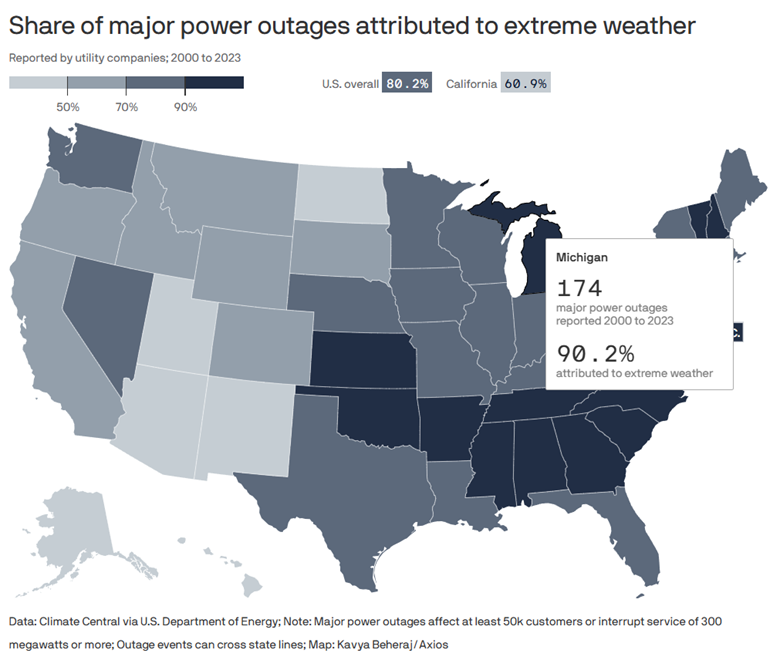
 Power Outages

Key Definitions:

  • Energy Resilience - Per DOE, it's the ability to “rapidly recover from power outages and continue operating with electricity, heating, cooling, ventilation, and other energy-dependent services” like production
  • Mitigation - Reducing the source
  • Adaptation - Managing risks and addressing impacts

Key Strategies:

  • Advanced planning and risk-aware company culture
  • Backup power/energy storage, including generators and batteries
  • On-site energy generation, including solar and CHP
  • Flexibility in production times and processes
  • Redundancy in process equipment and lines
  • Maintaining extra stock
  • Quid pro quo arrangements with similar manufacturers

Learn More:

  • DOE Screening Tool for Industrial Resilience
  • Michigan RRC Resiliency Toolkit
  • Addressing Barriers to Resilience in Michigan
  • Climate Resilient Pathways: Catalyzing Private Sector Action
  • Resiliencemetrics.org

More Info